Sunday, November 17, 2013

Brittany Hood
Period 2

The Secret Life of Bees

The Secret Life of Bees by Sue Monk Kidd is an inspiring tale about a young fourteen year old girl named lilly who is living in South Carolina in 1964. Throughout the story the narrator follows Lily's journey of renewal. Lily lived with only her father and her housekeeper Rosaleen who had been thrown in jail and beaten by a few racist men. After lily broke Rosaleen out of the hospital they started off on their journey together in search of a new start where the two of them could be at peace and find a permanent place to call home. With this mindset they eventually come across a farm where three woman live as beekeepers. Lily navigated herself here by visiting an address on the back of a picture she had of the black Mary, which belonged to her now deceased mother, which had Tiburon, SC written on it. Lily and Rosaleen made their way to Tiburon and there they entered a small general store for lunch where they saw the same picture on a honey jar. The store clerk led them to this farm and there they lived with three women and learned the ways of beekeeping. There Lily discovers many truths and emotions that she never had expected. 

I do not believe that this book should have a specific age requirement to read because it is an absolutely wonderful and wholesome story following a young girl, which I think many people can relate to in one way or another. In chapter eight, August, once of the three beekeeping women, explained to Lily that, "most people don't have any idea about all the complicated life going on inside a hive. Bees have a secret life we don't know anything about." To me this quote is not only significant because it reflects the title of the book, but I also think it sums up the entirety of the point the book is trying to make very well. Lily had gone to these peoples home and they accepted her and let her in without knowing what her life really was, despite the lies Lily had fed them. They accepted her, white skin and all, and let her into their lives and have her a home. The south in the 60's was still a heavily segregated time and for a young white girl to be accepted into the home of three religious black women is a bit unusual. Overall 

Friday, November 15, 2013

Arvanitis Colour of Magic interpreted in dance

http://studio.stupeflix.com/v/Z2yJw6IXZw/

Leahs video

check out my video you guys :) https://www.youtube.com/watch?v=8gmz_HhhD3M

Arvanitis Colour of Magic Book review

The Colour of Magic written by Terry Pratchet is a fantasy book written in the style of an Odyssey. The book begins with the two protagonists of the story Bravd and Hublander standing on top of a hill watching several establishments in the town burn down and betting on what the cause was. As they are watching the flames engulf several parts of the town a wizard comes up to them and confirms Bravd's suspicion that the fire was caused by an explosion in one of the factory's which produced magic. The scene then shifts back in time to when a ship came to port in town on which the antagonist is introduced. This story continues then follows each of the character's stories listed above until they meet at sea several years in the future. This book is broken up into four different parts, each following a different section of the hero's and villain's journeys. This is a book which takes place in a universe which resembles the medieval ages in which the class system is very distinguished and technology is equivalent to Europe's 16th century. Other than this, however, this story is one which is told in a completely different setting than earth. Magic is a commodity and Pratchet makes the story into one completely based off of fantasy with no real basis to it's universe other that to slightly resemble earth. This book is one that those who really enjoy fiction would enjoy, however many of the concepts are so different from what we understand that it occasionally feels as though only the one who generated those ideas would understand them.    

Should I? by Andrew Garcia


Should I?


I am without a companion.
without someone to stand by with.
I have no shoulder to cry on.
Is he really my friend?
Is she really me friend?
I still need to keep away.
But why?
I want to be closer,
but I can’t.
I love them.
and I can’t be with them.
Why not?
They said to keep away.
Do you want to see them?
but I can’t.
I need to keep away.
You need to act.
You can’t let the world pass you.
Act.
Be your own driver.


The book The perks of being a Wallflower is about teenagers and their journey through the coming of age. Charlie, Sam and Patrick are the main characters, who discover the problems of becoming teenagers. "You can't just sit there and put everybody's lives ahead of yours and think that counts as love." (198) This is my favorite quote in the book because Sam tells, the main character, Charlie that he is letting everyone else tell him how to live his life, but he does not do what he really wants to do in life. My poem goes more into depth on this, and how Charlie finds it difficult to show to people what he thinks is best, and what he honestly believes. We see Charlie’s passive nature as he is dating Mary Elizabeth, but actually does not like anything about her, and doesn’t want to date her, but has trouble telling her. In my poem it says “Do you want to be with them? but I can’t.” This represents Charlie and how he struggles to tell the girl who he actually loves, Sam, how he really feels about her.


Thursday, November 14, 2013

The Girl in the Green Raincoat


          In the book, The Girl in the Green Raincoat by Laura Lippman, Tess Monaghan, a pregnant private investigator, is stuck in bed due to her doctor’s orders. Everyday she sees a woman in a green raincoat, on her phone, walking her dog though the park, but one day when the dog is roaming around with its owner nowhere to be seen, Tess knows something is wrong. From her bed, she unveils the mystery of the disappearance of the woman in the green raincoat while questioning aspects of her own life, such as if she is ready to be a mom and why her boyfriend has stopped asking her to marry him. Not only is the mystery solved, but the characters develop as readers explore the lives of each one of them. The Girl in the Green Raincoat is recommended to those who enjoy mysteries along with reading about characters' internal conflicts and watching them solve their problems. Although the plot is not very well developed, and it seems to skip around to different scenes without smooth transitions, this quick read is right for those who are looking for a short, simple novel. For the people who think that they may be interested in The Girl in the Green Raincoat, just try reading it. If you don't like it, put it down. Otherwise, join Tess and enjoy unraveling the mystery of the disappearance of the girl in the green raincoat.

Paper Towns Book Review- Jenn Martin

Jennifer Martin
English Period 2
11/15/13
Paper Towns
John Green's heartwarming, and witty best-selling novel Paper Towns, is yet another one of his engulfing reads that keeps readers on the edge of their seat throughout the entire story. Set in Orlando, Florida, the author describes the life of high schooler Quentin Jacobsen, mainly known as "Q", who has spent his lifetime obsessing over Margo Roth Spiegelman, the girl next door. On the outside she appears to have it all from being the most popular girl in school, to her looks and her personality. However, his whole vision of her changes when one night she arrives at his window and sneaks him out of the house so that she can have him drive her around for a night of adventures and revenge toward her ex-boyfriend and now ex-best friend. Their night consists of pranking, spray-painting, and "breaking and entering". Quentin’s view of Margo changes from the most perfect girl in school to a mysterious, unruly teen with evil intentions that are directed toward specific people. She is certainly not the person who he perceived her to be. Also, she brought out a rebellious, outgoing side of Quentin that he never knew he existed. After that night he truly believed that everything, including his social status, would be different the next day in school. However this was only an idea of his imagination because he soon finds out the next morning that Margo is not present in school and learns three days later that she had run away, leaving him with clues to her location. With the help of his friends and the clues she left him, Q attempts to find Margo and must face many obstacles along the way.  This intriguing mystery and realistic fiction novel explores the notion that "you can never truly know a person until you get to know them". As Margo describes, people are not made of paper or two dimensional, we have dimensions. This means that there is more to a person than what appears on the outside and people are not always what they seem. Margo expresses how, "That always seemed so ridiculous to me, that people wanted to be around someone because they're pretty. It's like picking your breakfast cereals based on color instead of taste" (37). She shows Quentin her true personality and teaches him this important life lesson.  Overall, although the middle of the novel becomes slow as when Quentin cannot overcome the obstacles that will help guide him to Margo's location, the plot is still extremely suspenseful and grabs the reader’s attention. The characters are extremely relatable and well developed. They deal with real life situations that teenagers in high school can relate to. It was also a really enjoyable story because you could get a feel for the character's emotions and thoughts. This book is for anyone who is looking for a quick and easy read because it is suspenseful, captivating, and a great work of writing.

Big brother


War is peace
Freedom is slavery
Ignorance is strength
          That is the motto of the totalitarian regime which rules over the dystopian society portrayed in George Orwell’s book 1984. The book 1984 is a riveting tail of a man named Winston and his journey of hatred, love, and confusion. There are three superpowers ruling over the world in this novel, Eastasia, Eurasia, and Oceania. In Oceania, the country in of which Winston resides, there are four ministries the Ministry of Peace, the Ministry of Plenty, the Ministry of love, and finally the ministry of truth were Winston works. The names of these ministries are direct contradictions to their actual function, “The Ministry of Peace concerns itself with war, the Ministry of Truth with lies, the Ministry of Love with torture, and the Ministry of Plenty with starvation”(Orwell 1984). These contradictions are known as doublethink, or “controlled insanity” (Orwell 1984). Winston realizes this and decides to commit thought crime, which is the act of thinking independently of the party. It is with that decision that Winston’s story begins. Overall, the story of 1984 is an original classic which is guaranteed to enthrall you with this dystopian vision of the future.

“War is peace
Freedom is slavery
Ignorance is strength”
          Why would the party say war is peace, when it is not, why say freedom is slavery, when it is not, and why say ignorance is strength, when it is not? The answer is simple, doublethink. Doublethink is the process in of which big brother deceives itself and its people. It is the act of self-deception; Doublethink is accepting two differing lies as one singular truth.  Doublethink is part of one on the underlying themes of the novel 1984, that theme is that the only weapon against oppression is thought crime, and the only weapon against thought crime is doublethink. The act of individual thinking is thought crime, and once that happens the party loses power and crumbles. That is part of the reason big brother is so successful in his oppression of his people. They do not simple kill those who dare to think they change them “We do not destroy the heretic because he resists us: so long as he resists us we never destroy him. We convert him, we capture his inner mind, we reshape him… We bring him over to our side, not in appearance, but genuinely, heart and soul.” (Orwell 1984). The other reason big brother is large and in charge, because he uses doublethink not only to deceive his people but himself, and the best lie is a lie that you yourself truly believe.    


1984 rap:
Livin, livin in a world lies
Aint no freedom aint no privacy
Only big brother watching over you
“Protecting you”

War is peace
Freedom is slavery
Ignorance is strength

Only one truth I know in a sea of lies
Freedom is to say 2 + 2 = 4 not 5

There is this one pleasure reserved for the state
then one day came Julia and we went on a date
we met out of the city and went into the woods
and there under the trees she showed me the goods
it was treason, it was love, we were simply misunderstood 


One day we were betrayed into capture
And now I reside in prison awaiting some more fractures 
the government is hard
their beliefs are cold
All they do is remold 
Rebellious minds into their control 

War is peace
Freedom is slavery
Ignorance is strength


Pain, fear, emotions too great to describe
Flooded through me day in day out
Until one day, one moment I realized

2 + 2 = 5


Josh Willis Perks of Being a Wallflower


Josh Willis
Mr. Bauks
Perks of Being a Wallflower
The main character, Charlie a fifteen-year-old boy, has begun his freshman year in high school. Charlie already has social anxieties, as well as being terrified to start high school by it self. On top of that, he has to deal with the suicide of his friend, Michael.  Finally, Charlie meets step brother and sister Patrick and Sam and they decide to bring him into their click. After being introduced into this new group Charlie is lead into a whole new world of drugs, alcohol and literature.  Near the end of the school year a horrible secret arises about a close family member to him. The Charlie writes to us through the use of letters all addressed to an anonymous friend.


Throughout the book Charlie expresses the theme of understanding.

Overall, this book would be perfect for a copious amount of people who have entered or are about to enter high school. This book covers all the topics that someone is bound to encounter throughout your high school career. One thing the author did well in this book was some of the viewpoints and lessons learned . For example, Charlie knows exactly what is going on and he doesn't use a filter. For example, when he talks about family gatherings he discusses how he enjoys them not only because he gets to see his family but he enjoys watching everyone bicker. This Thanksgiving is no different from any other. As usual the small verbal arguments break out until they are stopped by being able to watch Charlie’s brother play football. Finally when the family is sitting down and its Charlie’s turn to say what he is grateful for he says, “I’m thankful that my brother played football on television so nobody fought” (60). Throughout the book there are constantly these little scenes were Charlies voice takes over. As well as those moments there are many lessons you learn along the way.

Wise Man's Fears Poem hoy

Colin Hoy
Wise Man’s Fears Poem
Young Kvothe had a talent for the lute
His skill was higher than that of any man could hopefully shoot
Orphaned as a young boy to a terrible tragedy
He had to learn to live on the streets
And to sleep cold without any sheets
But as all stories do Kvothe found his luck
And easier though, than one could shoot a duck
By finding money he was able to follow his dream
That the leaders of the university would hopefully deem
Him fit enough to study and learn
And absorb all the knowledge before class was adjourned
It is an epic fantasy
Of perseverance and victory
That can only warm your heart
And light a smile on your face
Although a long book
It has a high energy pace
With twists and turns that
Can only mean that this book is an ace
A classic story of an underdog
Weaved in with beautiful storytelling
Is the perfect combination
Of a masterpiece in the making


Book Review - Into the Wild By Jon Krakauer

Into the Wild is a journey of a confused man with pathetic priorities heading into the wilderness completely unprepared, inevitably he died. Yet his journey, and how he perished, is widely unknown and disputed. It is the creative author, Jon Krakauer’s job to use this man’s journals and follow his camps to find out what happened and write his story. He outlines the journey chronologically in the way someone would write an adventure novel, as if it is all had happened and it was a re-telling. The man who perished, Christopher Johnson McCandless, starts his journey when he graduated Emory University in Atlanta. He decided to spend his summer traveling in his car. Then when he mails his final college transcript away, he sends a letter to his family saying, “Hey, I’m not coming home and you’ll probably never hear or see me again <3”. So, he decides to throw himself into the wilderness, with what little money and supplies he has. Taking small jobs and shelter along the way. The story is his journey, not his destination, which is a really interesting way to approach a book. In chapter 8 of the story, a reader commented to the newspaper that posted about McCandless’s story states “Why would anyone intending to 'live off the land for a few months' forget Boy Scout rule number one: Be Prepared?” (71)This is interesting because it did a really swell job of making McCandless look like an stubborn fool, which is not something very disputed at this point in time. But, beyond the story, it really shows that these petty rules that the boy scouts make actually mean something; anything could save you. Being prepared could mean anything as simple as having a map. All in all, the book was well written and riveting, unfortunately the honours student savant that McCandless was supposed to be happened to be little less sensible than you would think someone of such a high caliber would be. He would not bring something so simple that could have saved his life in many ways.

Final Thoughts: Pick it up if you want a short book that has some interesting meanings and a bit of adventure, sadness, and sleuthing for your own opinions of what happened (if you're up to it).

Wednesday, November 13, 2013

The Wise Man's fears Summary hoy


Colin Hoy
English 2A
Bauks
11/11/2013
Wise Man's Fears Summary
These last few weeks I read the book The Wise Man's Fears, by Patrick Rothfuss.  This book is a fantasy novel of epic proportion, and is truly a good read.  It is the sequel to Rothfuss's previous novel, The Name of the Wind, which I recommend equally.
The book is about a young boy named Kvothe, who is extremely intelligent and clever, who always runs into trouble.  His parents were murdered when he was a boy and is currently living and studying at the University, a school for scholars and those of incredible intellect.  The University is the only school like this, and is extremely expensive and difficult to get into.  The tuition each year is based on a test, given by the heads of the school, the higher the score the lower the tuition.  Kvothe, who is not from a wealthy family, instead a traveling troupe, called Edema Ruh, does not have much money to pay for his tuition, so a high score is critical to him.  Luckily for Kvothe, he gets one of the lowest tuitions ever at the University.   
Throughout the rest of this amazing book filled with adventure and disaster, Kvothe spends his time at the University searching for any sort of evidence in the vast library about a mythical creature called the Chandrian, which had supposedly killed his entire family.  Along with this quest Kvothe finds himself in a bitter rivalry with another boy at the University named Ambrose, who is a rich, spoiled slob from the family of a wealthy baron.  Whenever something good happens to Kvothe, Ambrose always comes around to ruin his life, for instance, when Kvothe was about to take maybe the most important test of his life Ambrose poisoned him, “I’m going to kill Ambrose… for poisoning me” (178).  Just before Kvothe was about to take his second exam for the next years tuition, Ambrose slipped a potion into his food that would surely make him fail. 
This book is a great rollercoaster ride of ups and downs, and triumph over all odds.  I recommend this to anyone who can read and understand literature, because it is a compelling story of a young underdog who goes through hell and back again to avenge his parents’ death, and puts up with unimaginably difficult tests of his willpower.


A Clockwork Orange summary and review

Katherine Sullivan

“We can destroy what we have written, but we cannot unwrite it.” 

“Each man kills the thing he loves.” 

“The important thing is moral choice. Evil has to exist along with good, in order that moral choice may operate. Life is sustained by the grinding opposition of moral entities.” 

A Clockwork Orange by Anthony Burgess follows a vicious fifteen year old named Alex and his band of friends, whom he calls his "droogs". They commit heinous acts together. These acts they commit are ultra-violence. The story follows Alex through all of his ups and downs of going to prison, getting help and his reintroduction to the world. It is a dark and cynical satire. I only recommend this book for people who enjoy horror movies or dark dystopian novels. Overall, this book kept me on the edge of my seat. It was hard for me to put it down because I had to keep reading to find out what happened next. The language used in the book is confusing at times, but it is well worth it. Anthony Burgess did a marvelous job of writing this story and it is truly a classic.

Hotel on the Corner of Bitter and Sweet


Despite the cliche title, Jamie Ford’s novel, Hotel on the Corner of Bitter and Sweet, was surprisingly intriguing. It takes place in the 1980’s when a Chinese man, Henry Lee, sees a crowd outside of the Panama Hotel down the street from his home in Seattle. Revisiting the Panama Hotel took Henry back to the memories of his childhood in the 1940’s. It was the height of the war and Pearl Harbor was just bombed, so it was a difficult time to be Asian in America. Henry's father wanted Henry to live the American Dream and so to prevent him as being mistaken for a Japanese, he forced Henry to wear a pin saying "I am Chinese." Henry went to a private school on a scholarship and was the only non-white until a Japanese girl, Keiko Okabe, entered the school. Keiko and Henry instantly bonded over being bullied and just enjoyed each others’ presences in general. Soon after forming a relationship, they learn that all Japanese families including the Okabes were going to be shipped off to internment camps. Because each family was only able to bring one suitcase, Henry voluntarily hid the Okabes belongings in the Panama hotel. He then insisted that the Okabes take his pin and pose as Chinese so they could escape their forced departure. "She can stay with us, or my aunt. I'll find a place where she can stay. I'll get more (pins). I'll go back and get more for all of you," Henry rambled (134). This scene showing Henry's desperation proved his love for Keiko and was the most powerful scene in the book. The Okabes graciously declined knowing they had to leave. After they were taken away, Henry was crushed that he was never able to express his true feelings to Keiko, and so he traveled to various internment camps to visit the Okabes. The story explores the challenges of being discriminated against as a kid and losing a first love. Ford weaves historical content into the story while allowing the reader to fall in love with Henry and Keiko's relationship. Hotel on the Corner of Bitter and Sweet is a highly recommended novel that is hard to put down.
The Art of Racing in the Rain
The Art of Racing in the Rain, by Garth Stein is a book that is told in the perspective of a dog.  Enzo is very intelligent compared to other dogs. He understands life and has learned by watching lots of TV and by observing his owner, Denny. Denny is race car driver with a big heart that Enzo admires. Enzo has a passion for racing just like Denny and learns that life isn't always about speeding ahead; it’s about enjoying little moments that turn into a collection of memories. Throughout the book Enzo remained loyal to Denny and always supports him. Their relationship is special because Enzo understands Denny and they trust each other. Throughout the book, the reader can tell that they really want the best for each other, and never doubt their decisions.  Denny leads a rough life and has to deal with the struggle of money, death, family, and remaining true to his beliefs. The book begins with Enzo dying and he is remembering everything that has happened in his life. The book is very sad, but it ultimately allows people to understand the true meaning of life and the importance of family, love, hope, and trust. One of the most prominent themes in the book is hope. Enzo and Denny always have hope and stay true to their beliefs. By staying hopeful they are able to fight through the worst of times and finally end with love and happiness. People should read this book because it is a meaningful story that helps with understanding the importance of enjoying life and living it to its fullest. 

Quotes:
“There is no dishonor in losing the race. There is only dishonor in not racing because you are afraid to lose.” 

“To live every day as if it had been stolen from death, that is how I would like to live. To feel the joy of life, as Eve felt the joy of life. To separate oneself from the burden, the angst, the anguish that we all encounter every day. To say I am alive, I am wonderful, I am. I am. That is something to aspire to.” 

Zeldes The Book Thief


The Book Thief by Martin Zusak is an interesting piece of historical fiction. Taking place during World War II Germany, it takes a look at German Citizens during the war rather than the normal World War II books that analyze the lives of Jews or soldiers. Told from the perspective of death, the main character is Liessel Memminger, the daughter of a communist. After her mother is sent to a concentration camp, she is adopted to a German family who struggles to accept the Nazi policies led by Adolf Hitler. As a result, they live a life in fear but still manage to hide a Jewish man in their basement. In wartime, they struggle to maintain a good lifestyle with money coming in slow and tough rations to deal with. Leisel aspires to read but with tough Nazi book policies, it is very hard to acquire books for a reasonable price.
This piece of historical fiction told in poetry style through 

death is an awesome piece of literature. This book is an 

interesting perspective on World War II and is renowned 

around the world. This book is recommended for all readers.

Tuesday, November 12, 2013

Empire of the Summer Moon Summary & Book Review - Bobby Becker

       Empire of the Summer Moon, by S.C. Gwynn, is the analytical overview of the Comanche's ascertaining of power over the plains, and then their fall to U.S. westward expansion. Gwynn chronicles the Comanche’s rise to power in the eastern plains of Oklahoma and southern rockies of Colorado. After being forced south from the northern midwest by stronger tribes, the nomadic Comanche found refuge in a desolate area that no other tribe wanted. When the Spanish began their northward expansion above the rio grande, they faced a threat like no other. Unlike the structured and civilized Inca and Aztec societies, the nomadic Comanche had no single leader nor capital. This unstructured society and the inevitably, that Spanish horses would get into the hands of the Comanche made it very hard to fight them. Unlike almost every other tribe, they adopted horses into their military, and would no longer fight on foot. This new speed and power that the horses gave to the Comanche was overwhelming for the Spanish, and eventually prevented them from moving north. However, when new technologies were invented, the Comanche would not be able to hold up as well against U.S. westward expansion. 
       Empire of the Summer Moon was interesting because it challenged the misconception that he Native American tribes simply rolled over and were crushed by the modern armies. It shows how the Comanche gave a tremendous stand, overwhelming the Europeans on many occasions. While this book is historical non-fiction, it reads like a story and was very interesting. Gwynn’s explanation of the attack on the Parker’s fort in western Texas shows the grim fear that would have been experienced by the early settlers, and the history to what would one of the greatest Comanche leaders of all time. While the there is a massive amount of content in the book, it reads like a story and shows both sides of the conflict. It has a massive amount of true content on the history of the Comanche, but unlike a school textbook, it has shocking stories and accounts that keep the reader interested. Overall, it was a good read, but would not be recommended for those who are easily bored while learning about history.

Interpretive Dance

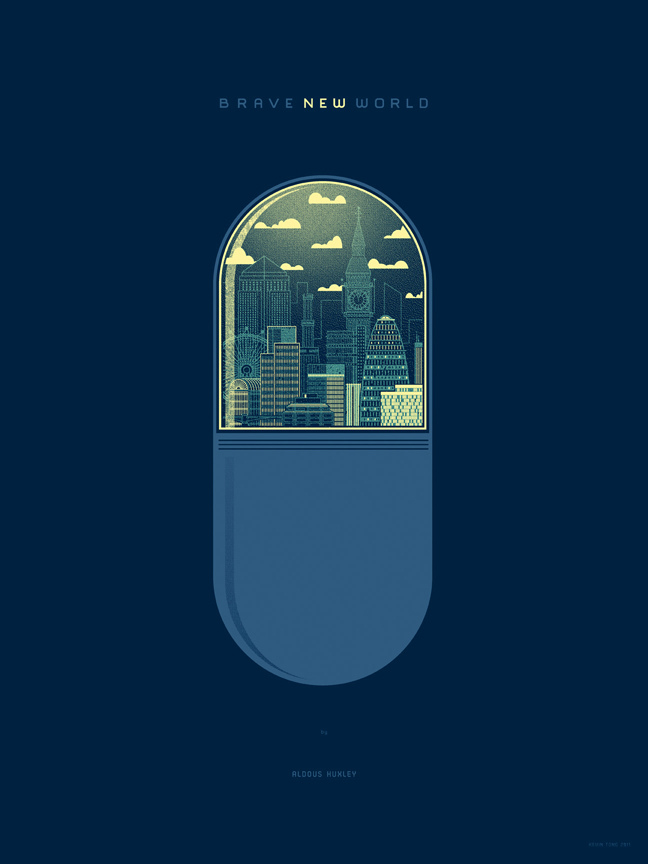
The Future We Strive For: COMMUNITY, IDENTITY, STABILITY

What would you rather have: happiness for your whole life or the truth?  In Brave New World, by Aldous Huxley, scientific advancements enable a futuristic dystopian government to create a society based on happiness, not truth.  There are no mothers and fathers, no families and relatives.  There is no social instability.  Everyone is essentially the same--grown in labs all from the same egg (definitely not born)--with the only exception being specialized growth to form different social classes.  Everyone is happy with themselves.  Drugs (soma) and sex are a social norm and are encouraged by the government.  People live to enjoy themselves.

There are however, in every society, a few defects; people who see more in life than the physical things that most people satisfy themselves with.  This is Bernard Marx.  The problem with Bernard is that he knows something is missing: the truth.  To him, life isn't just about the constant influx of soma, but rather recognizing beauty, reaching out beyond the status quo.

This Novel is the story of truth and sacrifices.  Unlike George Orwell's 1984, this book shows a dystopia oriented not around the success of the government, but rather the happiness of the people.  In both novels, the theme of censorship plays a large role in maintaining order, and in both novels the "ruler" knows perfectly well about the past.  These same ideas also display themselves in Ray Bradbury's Fahrenheit 451.  In all three of these classic novels, it is evident that times will change and our understanding of science and technology will increase.  Huxley portraits they future as a happy place, in fact, it's illegal to be unhappy, but is that future worth striving for?

“I don't want comfort. I want God, I want poetry, I want real danger, I want freedom, I want goodness. I want sin.” -The Savage

An Abundance of Katherines Book Review - Zoe Fox


Zoe Fox
Mr. Bauks
11/11/13 

An Abundance of Katherines


Colin Singleton is a prodigy and genius that recently graduated from his high school. His nineteenth girlfriend named Katherine also very recently dumped him. Yes, all nineteen of his girlfriends have been named Katherine and breaking up with the nineteenth Katherine (known as “Katherine the Great”) made him extremely depressed. This is a realistic-fictional tale of Colin’s journey with his best friend Hassan, who was trying to get Colin’s mind off of his awfully rough break-up. With 10,000 dollars in his pocket and “a feral hog on his trail”, Colin is on a mission to prove a mathematical theorem he hopes will predict the future of any relationship and conceivably win the girl. The tone throughout is quirky, nerdy, and generally fun. I don't think that reading this novel will change any lives, but it will certainly get a lot of laughs at certain points. Although John Green by far is my favorite author, this is definitely not one of his better books. I have very high expectations for all of his pieces because I loved Will Grayson, Will Grayson, Looking For Alaska, and The Fault in Our Stars. I read The Fault in Our Stars three different times and loved it the same (or if not more) every single time. This book was very difficult to get into and enjoy at the beginning and definitely hard finishing. I think it's because of the plot line, because not much occurred at a time. I like reading a book that I feel like I absolutely can’t put down because I’m so involved with it, and I feel like I did not get into this as easily. Unfortunately, I probably would not recommend this book to anyone else who is looking into reading a John Green book. However, that does not mean I don’t love him or his work any less!

Ordinary People, Rolnick


Ordinary People by Judith Guest is an enticing novel about coping with hardships.  Conrad is the main character who suffers from depression after losing his younger brother, and his father and mother, Calvin and Beth, struggle to maintain their familial bond in opposing ways, as it is breaking.  With the help of a psychiatrist, Conrad and Calvin work towards healing, unlike Beth who leaves at the end of the book.  Link to more plot: http://www.sparknotes.com/lit/ordinarypeople/summary.html


With Ordinary People’s emphasis on the “average” human being, and how tragic events can happen to these ordinary people, I read the novel as if I was a part of Conrad’s family. Guest’s sophisticated writing method of putting the reader in Conrad’s shoes using relatable situations that the reader would understand, is effective.  Guest writes in Conrad’s perspective, “In the early morning, the room is his enemy…He imagines himself safely inside; in bed, with the covers pulled up.  Asleep” (14-15).  Because it is a universal feeling to wish that one is “in bed, with the covers pulled up” in the early morning, the reader imagines himself as Conrad, and will then imagine himself as Conrad when Conrad deals with depression.  This writing tactic creates for a better understanding of the novel, as well as a more enjoyable reading experience.  Also, the author writes in third person limited, alternating focus on Conrad and Calvin, emphasizing each one’s depth as a character and providing for greater analysis of the two.  I enjoyed Ordinary People, as it made me feel closer to tragedy as well as making me appreciate my younger sister and my family’s state.  Judith Guest’s style of writing is an interesting one, and I would recommend this book to anyone looking to broaden his knowledge of different writing tactics or looking improve his or her own writing skills.

Poetry:

It Could Be Me.

Could it be you who’s fate this is true?
It couldn’t be me, can’t you see?
I’ve been so good, well as good as a human could be.
How will I deal with these feelings so glum?
I’ve faced the fact that my life is now humdrum.
Should I end this pain once and for all?
Because life itself is starting to make my skin crawl…
But I can’t and I won’t, that’s not what Buck wanted.
But did he want me all my life, to feel awfully haunted?
I don’t care, I can’t do that to my mom and especially my dad.
After my therapy I’m feeling better, just a tad.
Accept and move on, that’s what we all must do.
We’re people, we’re ordinary, oh if Buck only knew…